Pages

Tuesday, February 21, 2012

Daily Newsletter February 21, 2012

Microbiology MOOC title3

Daily Newsletter February 21, 2012


Today, I wanted to review a little of what we discussed yesterday.

Genomics tells us the genetic possibility of an organism. Remember, we do not express all of our genes at the same time. That would be a waste of energy and resources. We have constitutive genes that are always expressed (why?), and regulated genes that are only expressed in the right environment. Genomics helps us to understand what the organism is capable of doing metabolically, but unless we know the regulatory mechanisms, we don't know which of the regulated genes is being expressed at a given time.

Proteomics gives us a snap shot of a cell's proteins. We can find out exactly which proteins have been expressed. We can take cells from a control and variable condition, and compare the proteomes. This comparison can tell us if there are specific proteins either made or missing when in the variable condition. This can help us understand regulatory mechanisms. But we may not be able to tell if all of these proteins seen in the proteome are active. Remember, we can inhibit proteins. We can also regulate their activity with allosteric regulators.

The Metabolome shows us all of the biochemical intermediates currently in a cell at given time point. In other words, it is a snap shot of the metabolic processes currently being carried out. This reveals which pathways are active, and how active they are. If we know our pathways and intermediates (and there are computer programs you can use for this), then you can determine the metabolic activity of individual enzymes (does the enzyme have a fast or slow rate). The metabolome can point us to where there are metabolic slow points or problems.

Metabolic Engineering combines genomics, proteomics, metabolomics and genetic engineering. We can optimize a specific pathway. We can remove regulation, provide strong promoters, and even a coding region for an enzyme with a fast reaction rate. We can duplicate genes, allowing for more of the gene product to be produced. In turn this will raise the Vmax of the reaction.

Having said all of that, this is not rapid work. It could take years to fully optimize a pathway. The resulting organism will most likely be a laboratory strain. In optimizing a specific pathway, you may be (and most likely are) increasing the energy and resource needs of the cell. This may result in the cell being a poor competitor in natural environments. Still, as a genetically engineered organisms, it must be approved by the government.

Readings:

Plant Genetic Engineering and Regulation in the United States
This is a short article. Though the focus is on plant genetics, the regulations go further.

NIH Guidelines for Research Involving Recombinant DNA Molecules
This page has links to various regulations overseen by the National Institutes of Health.

International Centre for Genetic Engineering and Biotechnology - General Introduction to Biosafety.
This website has a brief overview of biosafety, and concerns regarding genetically modified organisms (GMO).

Daily Challenge: As was mentioned yesterday, your challenges this week are in general about moving from genomics toward metabolomics. So there is not a required topic each day. Instead, look at things that are of interest to you in this over arching topic.

One option you have for your challenge is to talk about the regulations and ethics of making and using GEO/GMO. Feel free to give opposing view points, but make sure you have valid references to support your view. A person saying that it is bad on a website with no reference to current research or methodologies is not appropriate. There are well considered, well researched, and informative articles both for and against GMO. So be diligent in your search for references. NOTE: you can also write this as an opinion piece, but make sure that your opinion is justified and backed up with references to legitimate investigations and research.
EFSA statement on the fate of recombinant DNA or proteins in meat, milk and eggs from animals fed with GM feed 
This article from the European Food Safety Authority deals with Recombinant DNA remaining after ingestion of GMO feed.  A look at tracking recombinant DNA in the environment.

APHIS - Biotechnology
The animal and plant health inspection service, a unit of the USDA, is tasked with monitoring the release of genetically modified organisms (or genetically engineered organisms -GEO) into the environment.  The link goes to one of their Biotechnology pages involving gaining approval for the release of a GEO/GMO.

Monday, February 20, 2012

Daily Newsletter February 20, 2012

Microbiology MOOC title3

Daily Newsletter February 20, 2012

Administrative Note: This week, we are looking at Genomics through Metabolomics. Your book does not cover this specifically, and as such, this is a fairly open week. Each day, I will be sending you information on genomics, proteomics and metabolomics. It is up to you to determine your learning objectives.


What do I mean by that? The idea is rather simple, this week, I want to know what you want to learn. As a supplemental 4 point blog, tell the class what you want to learn about. In class, I gave you an idea of the possibilities. Do you want to learn about a technology? or an application? Using specific terms or phrases, what topics do you want to be able to discuss at the end of the week?


At the end of week, I'll give you a list of objectives that I will use on the next exam, but what is critical for you this week is to look at things you find interesting in this topic.


As such, there will be no daily topics. Instead, I'll list out resources that might be interesting to you. Each day for your blog, discuss some topic of genomics, proteomics or metabolomics that you find interesting. Remember, I am fine with you using wikipedia as a jumping-off point for your investigations

Suggested Resources:

Bacterial Genomics 101:  A quick review of bacterial genomics.

GLAMMInteractive Viewer for Metabolic Pathways and Experiments

Microbesonline: a site where you can look at and compare prokaryotic genomes.

Integrated Microbial Genomes:  a site for comparative genomics and annotation of known public genomes. (what does it mean to annotate?)

Genomics Directory:  A site with a number of useful short articles.

Introduction to Proteomics:  A fun interactive review of proteins and proteomics.

Prtoeome Sciences|Proteomics:  A corporate site describing their research tool.  It provides a good overview of proteomics.

Genomic Applications:  Algilent Technologies compiled a list of their genomic research tools based on applications.  A good site to jump-start an investigation into the types of genomic work being done.

HPLC Course:  Provided by the Academy of Chromatography, this is a great way to learn about High Performance Liquid Chromatography.  The tutorial section is geared for differed levels of understanding.  Start at novice and work your way up.

Practical Gas Chromatography:  This site is a good over view of the theory and practice of gas chromatography.

CHROMacademy.com:  This is an elearning hub for HPLC, GC and Mass Spec.  You can sign up for a free account and take online courses in these three techniques.  Because I think it is so amazingly cool and useful, I'll give you a point for every hour credit received on this site.  INSTRUCTIONS:  I take course reports up to March 15, 2012.  You will find an assignment link in uLearn to turn this in.  On the CHROMacademy site, you will find a report tab.  You can download an excel spreadsheet of your work.  Send that excel file to me.

Thursday, February 16, 2012

Daily Newsletter February 16, 2012

Microbiology MOOC title3

Daily Newsletter February 16, 2012

Today's Topic: Amino Acid Biosynthesis (Aromatics and Special Cases)

Yesterday we covered the basics of amino acid biosynthesis, but what about those amino acids that in humans are considered ESSENTIAL? 

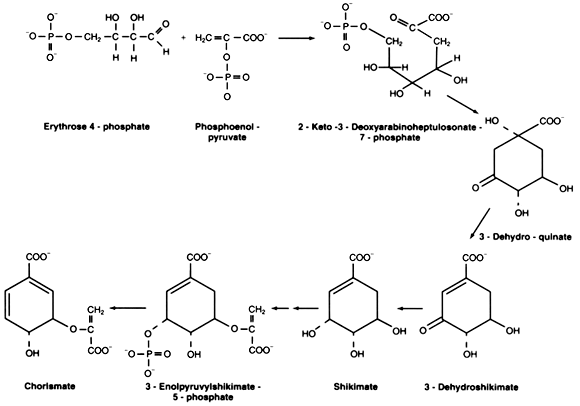
Aromatic Amino Acids contain an aromatic ring structure.  The pathway below shows the pathway to build CORISMATE (corismic acid), which is the precursor to all aromatic amino acids (can you name them?). 
  
The next pathway shows the biosynthesis of tryptophan:
 
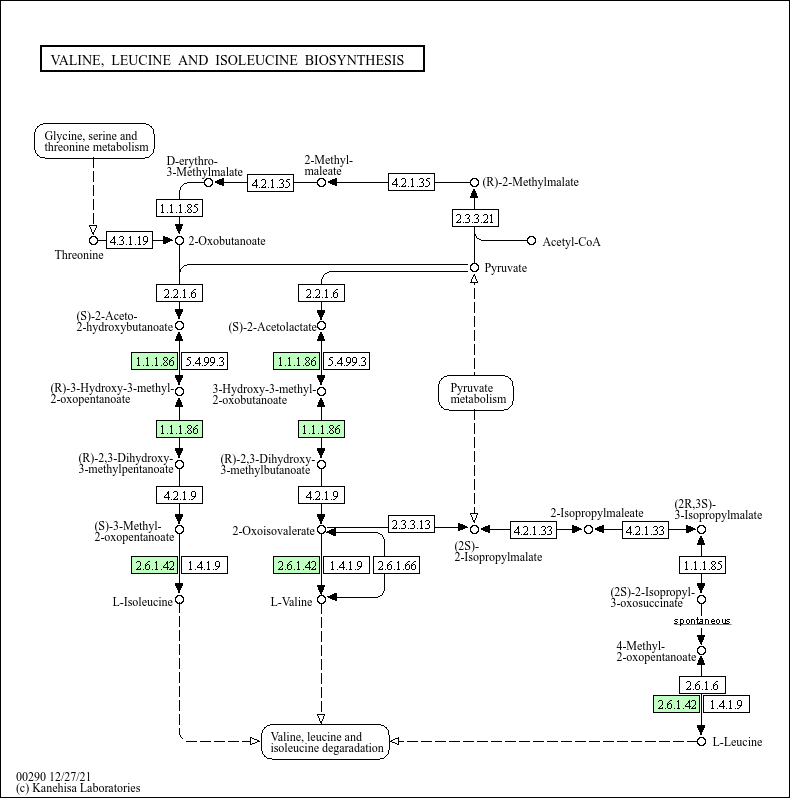
Below are the pathways for Valine, Leucine and Isoleucine biosynthesis.  The numbers are references to enzymes.  At present, you do not need to learn these.

Review these pathways.  Look them over, and research them if needed.  Your goal right now is to learn how to articulate these pathways.  What is happening?  What are the precursors that we are using?  Remember, central metabolism got its name for a reason.

Daily Challenge:
Clearly articulate the biosynthesis of tryptophan. Consider, what does it take to make an aromatic amino acid? Why would most animals have lost this capability?

Wednesday, February 15, 2012

Daily Newsletter February 15, 2012

Microbiology MOOC title3

Daily Newsletter February 15, 2012

Today's Topic: Amino Acid Biosynthesis

There are 20 amino acids used in translation, and each one has to be synthesized. One of the hardest components of the amino acid to get is the amino group. Nitrogen is the primary limiting nutrient in terrestrial ecosystems, so organisms either have to fix nitrogen or scavenge for it. (a good example of adaptation to nitrogen can be seen in insectivorous plants: they digest insects to get nitrogen).

Glutamate is one of the critical amino acids when it comes to biosynthesis, because glutamate easily undergoes transamination. In this process, the amino group can be moved to a ketoacid (usually from TCA) to construct other amino acids. So our first step in understanding amino acid biosynthesis is to look at glutamate biosynthesis.
Glutamate
 Above is the molecular structure of glutamate.  The enzyme that produces glutamate is Glutamate Dehydrogenase.  This enzyme reduces alpha-ketoglutarate from TCA.  During the reduction, ammonium can be added to the molecule.  Notice, this enzyme is reversible, and can oxidize glutamate.
Glutamate can then be used with Transaminase to make other amino acids.  Here is an example of glutamate pyruvate transaminase:


Daily Challenge:  Using your book and online resources, list all of the amino acids that can be made from glutamate.  Which of these are considered essential or non-essential amino acids to humans?  (do bacteria have essential and non-essential amino acids?).  Articulate at least two amino acid biosynthetic pathways not previously described.

Admin Note: Only one student has completed the calibrations.  Do not wait until the last minute.  You will only hurt yourself and your reviews if you wait.

Tuesday, February 14, 2012

Daily Newsletter February 14, 2012

Microbiology MOOC title3

Daily Newsletter February 14, 2012

Administrative Note: CPR Calibrations
Make sure you start your calibrations today. Do not wait until the last day to do all of calibrations and reviews. Give yourself time to do them. Pace yourself by doing one task each day until the close of the assignment. I have given you til Sunday to finish this task.

Today's Topic: Biosynthesis of Fatty Acids (Lipids)

Fatty acids are needed for triglycerides and phospholipids. Consider the number of phospholipids used in a cell membrane. Remember that cell membranes are dynamic, so you constantly have to replace phospholipids. Are you starting to see how often cells will need to manufacture fatty acids? A quick review of fatty acid biosynthesis.

The following image is of the Fatty Acid Synthesis II (FASII) pathway found in Escherichia coli.  With knowledge of metabolic pathways, can you follow it?  (FYI: ACP stands for acyl-carrier-protein)


Read the following article about fatty acid synthesis:
Bhatt, A., Molle, V., Besra, G. S., Jacobs, W. R. and Kremer, L. (2007), The Mycobacterium tuberculosis FAS-II condensing enzymes: their role in mycolic acid biosynthesis, acid-fastness, pathogenesis and in future drug development. Molecular Microbiology, 64: 1442–1454. doi: 10.1111/j.1365-2958.2007.05761.x

Remember, in reading this article, look at the introduction and then conclusion.  Skip the materials and methods until you understand what the authors are trying to tell you.
 <HR>
Daily Challenge:  Fatty Acid Biosynthesis
Your goal today is to convey an understanding of the importance of fatty acid biosynthesis and regulation, as well as to demonstrate comprehension of the metabolic reactions needed to make a fatty acid.  Focus your discussion by using Mycobacterium as a model for lipid production.

Monday, February 13, 2012

Daily Newsletter February 13, 2012

Microbiology MOOC title3

Daily Newsletter February 13, 2012


Daily Topic: Reductive TCA and the 3-hydroxypropionate cycle

Today in lecture we reviewed the Calvin Cycle as one of the priamry means on the planet to fix carbon. There are other ways of fixing carbon, metabolical pathways that predate the Calvin cycle. The TCA cycle, while associated with glucose catabolism, can be reversed if the organism has the correct enzymes. TCA can be turned into a reductive cycle, instead of an oxidative cycle. Your task today is to understand how and why organisms would use this autotrophic pathway.


Daily Challenge:
In your own words, describe the reductive TCA process. Don't focus solely on the how, but also the why. Why would organisms use this? What types of organisms do this? where do they live? How is the 3-hydroxypropionate cycle involved in some of the earliest autotrophs?

Special Blog Opportunity: Milestone Exam Revision
This week, you can revise your milestone exam in your blog for 4 points. For each question that you missed, you are expected to:
1: Explain why the keyed answer is the correct answer.
2: Provide a reference for your reflection.
3: Explain why you chose an incorrect answer.

Sunday, February 12, 2012

Weekly Update - Week 6 - Biosynthesis

Microbiology MOOC title3

Weekly Update Week 6 - Biosynthesis


Administrative Note: CPR
Your paper is to be uploaded by 11am Monday (2/13). Please note you will have to finish the pre-test and tutorial before you can access the assignment. DO NOT WAIT UNTIL THE LAST MINUTE!

When you first log into the site, you will use your Panther ID.
Do not use the initial zeros of your panther ID! If you keep the initial zeros, the system will say that you are not registered. Just put your Panther ID in again, this time without the zeros.

At present, the system is preventing you from doing the calibrations until the test submission time period is over.  You will be able to perform calibrations starting tomorrow.


Weekly Topic: This week we look at biosynthesis. While carbon fixation is a part of this week, a more important part is looking at the different types of biosynthetic reactions bacteria are capable of performing. During the week, I will be pointing you to various readings to help you appreciate the scope of bacterial biosynthesis.

Learning Objectives:
  • Be able to discuss the Calvin Cycle.
  • Be able to discuss the importance of Rubisco.
  • Be able to describe reductive TCA.
  • Be able to describe the importance of reductive TCA.
  • Be able to describe the biosynthesis of lipids and fatty acids.
  • Be able to describe the regualtion of lipid biosynthesis.
  • Be able to discuss the biosynthesis of polyesters.
  • Be able to discuss amino acid biosynthesis.
    • Be able to describe arginine and armoatic amino acid biosynthesis.
  • Be able to discuss purine and pyrimadine biosynthesis.
  • Be able to describe the biosynthesis of Tetrapyrroles.